Basement Foundation Waterproofing & Foundation Leak Repair in Waldorf, MD
Foundation-related water intrusion is water entering a basement or crawl space through or around the foundation—through cracks, wall and floor joints, porous masonry, or foundation penetrations. Waterproofing and leak repair address those entry paths, but water and structural movement are often connected: the same hydrostatic pressure that drives water inward can also crack and bow walls. This page focuses on water entering through the foundation and the relationship between water management and foundation conditions—because waterproofing alone does not correct structural movement that has already occurred.
Signs of a Foundation or Basement Water Problem
Water problems leave recognizable traces. Some are obvious, like active seepage; others, like efflorescence or a musty smell, point to moisture moving through the foundation over time. These signs identify where water is entering but not always why—determining the source is the next step.
Damp Foundation Walls
Walls that feel damp or show darkened areas where moisture is wicking through the material.
Water Stains
Discoloration on walls or floors marking where water has entered or pooled in the past.
Active Seepage
Visible water entering through a crack, joint, or the wall/floor intersection during wet conditions.
Wet Cracks
Cracks that are damp or actively dripping, indicating a direct path for water from outside.
Efflorescence
White mineral deposits left on the wall as water evaporates, marking moisture passage through masonry.
Moisture at Wall/Floor Joint
Dampness where the wall meets the floor, a common entry path under hydrostatic pressure.
Musty Conditions
A persistent musty smell that can accompany chronic moisture in a basement or crawl space.
Peeling Coatings
Paint or waterproof coatings bubbling or peeling as moisture pushes through from behind.
Recurring Wet Areas
The same area getting wet repeatedly, pointing to a persistent entry path rather than a one-time event.
Do not assume mold without verification. Musty conditions can accompany chronic moisture, but visible growth should be identified and addressed by qualified professionals. The role of a foundation evaluation here is to identify and stop the water entry path that creates the damp conditions—not to diagnose or treat mold itself.
What Causes Water to Enter Around a Foundation?
Water enters a foundation when an entry path exists and the water pressure or saturation outside exceeds the wall's resistance. The cause is often a combination of a specific opening and the drainage conditions driving water toward it. Not every leak comes from hydrostatic pressure—the source depends on the property.
Foundation Cracks
Cracks that create a direct path for water from the saturated soil outside to the interior.
Drainage Conditions
Poor surface drainage that allows water to pool and saturate the soil against the foundation.
Hydrostatic Pressure
Water pressure that builds in saturated backfill and forces moisture through cracks and joints.
Grading
Ground sloping toward the foundation rather than away, directing runoff to the wall.
Gutter & Downspout Discharge
Downspouts releasing water too close to the foundation, saturating the backfill.
Wall/Floor Joints
The joint between the wall and floor, a common entry path under pressure from below.
Porous Masonry
Block or concrete that absorbs moisture over time, allowing slow seepage without a visible crack.
Foundation Penetrations
Openings for pipes or utilities that provide a path for water if not properly sealed.
Exterior Waterproofing Deficiencies
Aging or missing exterior waterproofing or drainage that allows water to reach the wall.
Foundation Leak Repair and Waterproofing Options
Leak repair and waterproofing options range from sealing a specific crack to managing water around the entire foundation. The right approach depends on where water is entering and whether structural movement is also contributing.
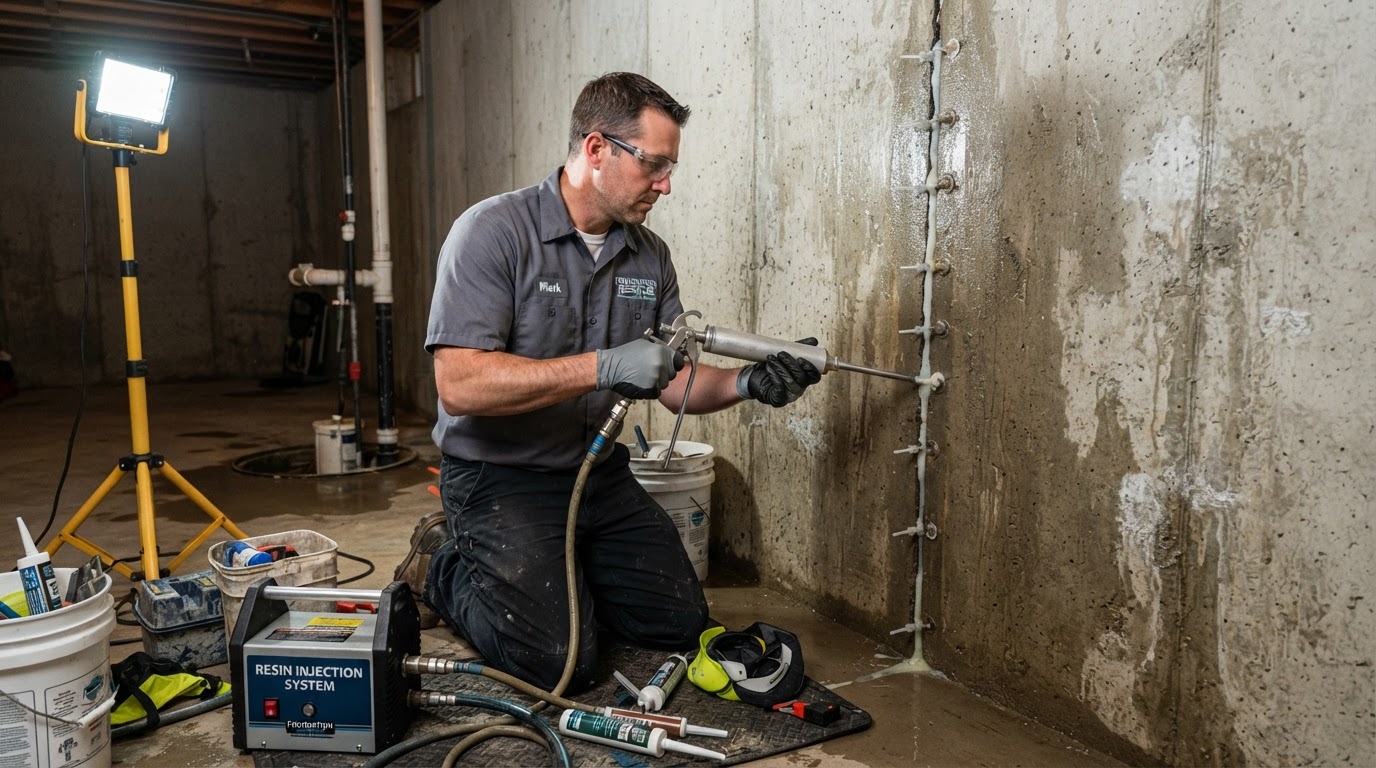
Crack Injection & Sealing
Epoxy or polyurethane injection to seal cracks against water and restore continuity where appropriate.
Exterior Waterproofing
Exterior membrane or coating approaches that keep water from reaching the wall.
Interior Drainage Systems
Interior perimeter drainage where appropriate to collect and manage water that reaches the foundation.
Wall Coatings & Membranes
Interior or exterior coatings that resist moisture passage through porous masonry.
Drainage Improvements
Grading, gutter, and downspout corrections to reduce water reaching the foundation.
Structural Foundation Repair
Stabilization of cracks or walls where structural movement is contributing to the water entry.
Waterproofing
Waterproofing manages water entry through cracks, joints, and porous masonry using injection, coatings, membranes, or drainage. It addresses the water, not the structure.
Water management
Water management controls how much water reaches the foundation through grading, gutters, downspouts, and drainage. Reducing the water reduces the pressure driving infiltration.
Structural repair
Structural repair addresses movement—settlement, wall deflection, or support failure—that may be causing or worsening the water entry. Waterproofing alone does not correct structural movement.
When a Foundation Leak May Need Structural Evaluation
Some leaks are purely a water-management problem. Others signal that the foundation is moving—and in those cases, sealing the crack without addressing the movement leads to a reopened crack or continued deflection. The following situations warrant structural evaluation alongside any waterproofing.
Cracks Changing Size
A leaking crack that is widening over time, suggesting active movement rather than a stable opening.
Horizontal Wall Cracks
A horizontal crack leaking water, the pattern most associated with inward wall movement under pressure.
Bowing Walls
A wall that has deflected inward and is also leaking, indicating pressure and movement together.
Displacement
Visible offset or displacement at a crack, indicating the wall has shifted rather than simply cracked.
Settlement Symptoms
Water entry alongside sloping floors, sticking doors, or stair-step cracking that points to footing movement.
Recurring Cracks
Cracks that reopen after sealing, indicating that movement is ongoing beneath the repair.
Moving-Area Leaks
Water entering through an area that also shows cracking, displacement, or other movement signs.
Basement Foundation Waterproofing FAQs
Direct answers about foundation leaks, crack injection, hydrostatic pressure, and the difference between waterproofing and structural repair for homes in Waldorf and Southern Maryland.
Have a Foundation Leak or Water Intrusion?
If water is entering your basement through a crack, joint, or the wall/floor intersection, identifying where it is coming in—and whether structural movement is also involved—is the first step. Request an inspection or call to discuss what you are seeing with a foundation repair contractor near Waldorf.
Waldorf Foundation Repair • Serving Waldorf, MD 20601 • Charles County • Southern Maryland