Block & Concrete Foundation Repair in Waldorf, MD
Block and poured concrete foundation systems can develop different crack patterns and forms of deterioration or movement. Concrete masonry unit (CMU) walls tend to crack along mortar joints in stair-step patterns, while poured concrete walls more often develop vertical, diagonal, or horizontal cracks. Understanding the foundation material is the first step in reading the signs correctly—because the same visible symptom can mean something different in a block wall than it does in a poured concrete wall. This page focuses on repair considerations specific to each material.
Common Problems With Block Foundation Walls
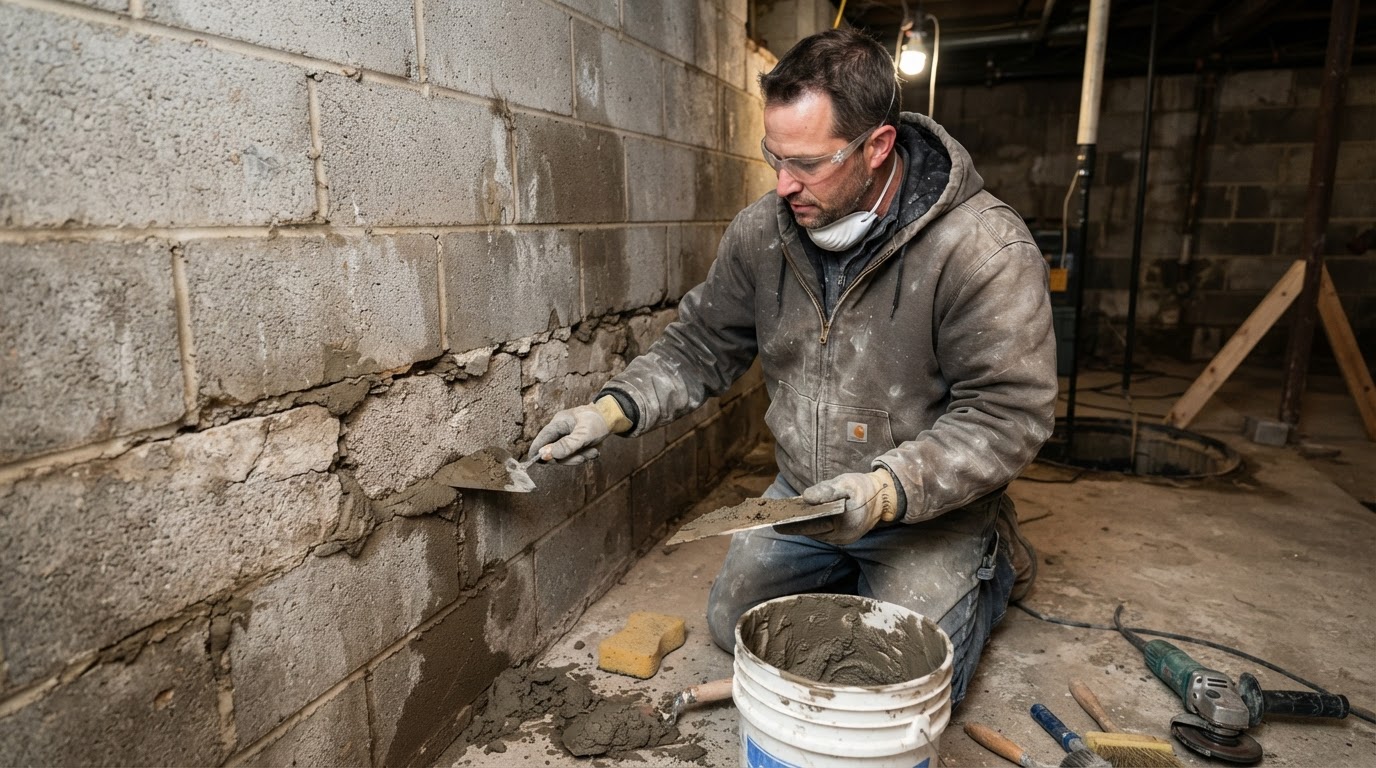
Concrete block foundations crack and move in characteristic ways. Because the wall is built from individual units bonded with mortar, movement tends to show up along the joints. Masonry crack patterns provide useful clues, but they do not establish the cause by themselves—an evaluation confirms whether the pattern reflects settlement, lateral pressure, or another condition.
Stair-Step Mortar Joint Cracks
Cracks that step through mortar joints, often indicating differential settlement or wall movement.
Horizontal Cracks
Cracks running along a mortar joint near the wall midpoint, associated with inward lateral pressure.
Displaced Blocks
Individual block courses pushed inward farther than those above or below, creating a visible step.
Open Mortar Joints
Mortar joints that have opened or eroded, reducing the wall's continuity and resistance to movement.
Bowing
Inward deflection of the block wall under sustained lateral soil and hydrostatic pressure.
Water Seepage
Water entering through cracks, joints, or the hollow cores of block, which can hold moisture.
Localized Deterioration
Spalling, crumbling, or deteriorated block or mortar in a specific area of the wall.
Movement Around Openings
Cracking near windows or openings where the wall is weakened and stress concentrates.
Common Poured Concrete Foundation Problems
Poured concrete foundations behave differently than block under stress. As a continuous wall, they tend to crack in vertical, diagonal, or horizontal lines rather than along joints. Some cracks are cosmetic; others reflect movement. The distinction between structural and non-structural cracking is made carefully, based on width, direction, and whether the crack is changing.
Vertical Cracks
Cracks running up the wall, often from shrinkage or settlement depending on width and movement.
Diagonal Cracks
Cracks angling from corners or openings, frequently tied to differential settlement.
Horizontal Cracking
A horizontal crack near the wall midpoint, the pattern most associated with inward wall movement.
Shrinkage Cracks
Thin, typically non-structural cracks from concrete curing and early shrinkage.
Settlement Cracks
Cracks that develop as a footing drops, often wider at one end and tapering.
Water Penetration
Moisture entering through cracks or cold joints, sometimes under hydrostatic pressure.
Wall Movement
Inward or outward deflection of the poured wall, measurable as a loss of plumb.
Surface Deterioration
Spalling or surface breakdown of the concrete that can expose reinforcement over time.
Structural versus non-structural cracking
Not every crack in a concrete foundation is structural. Thin vertical hairline cracks often result from normal curing and shrinkage. Cracks become a greater concern when they are horizontal, widening over time, accompanied by wall displacement, or part of a stair-step pattern in block. The direction, width, location, and whether the crack is actively changing all factor into whether structural repair is appropriate—and that determination is made through evaluation, not from the crack's appearance alone.
Block and Concrete Foundation Repair Options
The repair method depends on the underlying cause. A stable crack may only need sealing, while a crack tied to settlement or wall movement may require stabilization first. Matching the repair to the cause is what prevents a repaired crack from reopening.
Masonry Repair
Tuckpointing and repair of mortar joints in block walls to restore continuity once movement is arrested.
Crack Injection & Sealing
Epoxy or polyurethane injection to seal cracks against water and, where appropriate, restore continuity.
Wall Reinforcement
Carbon fiber or steel reinforcement for walls showing inward movement or recurring cracking.
Structural Bracing
Additional bracing tailored to the wall construction and the amount of movement.
Pier Stabilization
Helical or push piers to stabilize a footing that has settled and is causing cracking above.
Localized Reconstruction
Replacement of a severely damaged wall section where reinforcement cannot arrest the damage.
Why repair method depends on the cause: Sealing a crack that reflects active settlement will only reopen. Reinforcing a wall that is still settling addresses the wall but not the footing. The repair method is selected to address the specific failure mechanism—settlement, lateral pressure, support loss, or moisture—identified during evaluation, not applied generically to every crack.
Repairing Block and Concrete Foundations Near Waldorf
Evaluating a block or concrete foundation means reading the material, the crack pattern, and the wall's condition together. The evaluation determines whether the repair is a crack treatment, a wall reinforcement, or a footing stabilization.
Foundation Material
Whether the wall is block (CMU) or poured concrete, which shapes crack patterns and repair options.
Crack Pattern
The direction, width, and location of cracking and whether it follows joints or crosses the wall.
Wall Displacement
Whether the wall has deflected inward or shifted, measured against plumb.
Settlement
Whether the footing has dropped, producing cracking that widens or tapers.
Water Intrusion
Whether moisture is entering through cracks, joints, or porous material.
Exterior Drainage
How surface water and downspout discharge are managed around the foundation.
Prior Repairs
Whether previous repairs are holding or showing signs of renewed movement.
Structural Movement
Whether the cracking reflects active movement or a stable, historical condition.
Block & Concrete Foundation Repair FAQs
Direct answers about block versus poured concrete foundations, stair-step cracks, crack injection, and when a foundation wall needs reinforcement for properties in Waldorf and Southern Maryland.
Cracks or Movement in a Block or Concrete Foundation?
If you have noticed stair-step cracks in a block wall, vertical or horizontal cracks in a poured concrete wall, or displaced masonry, having the wall evaluated is the first step toward understanding whether the pattern reflects settlement, wall movement, or a stable condition. Request an inspection or call to discuss what you are seeing with a foundation repair contractor near Waldorf.
Waldorf Foundation Repair • Serving Waldorf, MD 20601 • Charles County • Southern Maryland