Helical Pier Installation in Waldorf, MD
A helical pier is a steel foundation support element with helical plates welded to a central shaft that advances into the ground using rotational force—similar to driving a large screw into wood. Rather than relying on impact or the building's weight, helical piers are mechanically rotated into competent bearing material below unstable surface soils, then connected to the footing through a bracket. Helical pier installation in Waldorf is one method of stabilizing foundations that have lost near-surface support, suited to a range of structures and site conditions.
When Are Helical Piers Used for Foundation Repair?
Helical piers are used when a structure requires additional support and suitable load-bearing soil can be reached below unstable or insufficient surface soils. Their rotational installation and capacity range make them well suited to several applications—though they are not always the preferred pier for every situation.
Foundation Settlement
Stabilizing footings that have lost near-surface bearing support by transferring load to deeper, competent material.
Structural Stabilization
Arresting downward movement of a foundation section where soil conditions have changed or weakened.
Home Additions
Supporting added structure where the new load requires deeper bearing than the existing soil can provide.
Porches & Attached Structures
Stabilizing porches, sunrooms, and attached elements that have settled independently from the main foundation.
Certain New Construction Support
Providing deep foundation support during new construction where surface soils are unsuitable for bearing.
Light Structural Support
Carrying lighter loads where the rotational installation method and capacity range of helical piers fit the application.
Not always the preferred pier. Helical piers are one option among several. Heavier existing structures may be better served by push piers, which use the building's weight as reaction force. Whether helical piers fit a given property depends on the load, the soil, and the access— determined through evaluation rather than assumed.
How Helical Piers Stabilize a Foundation
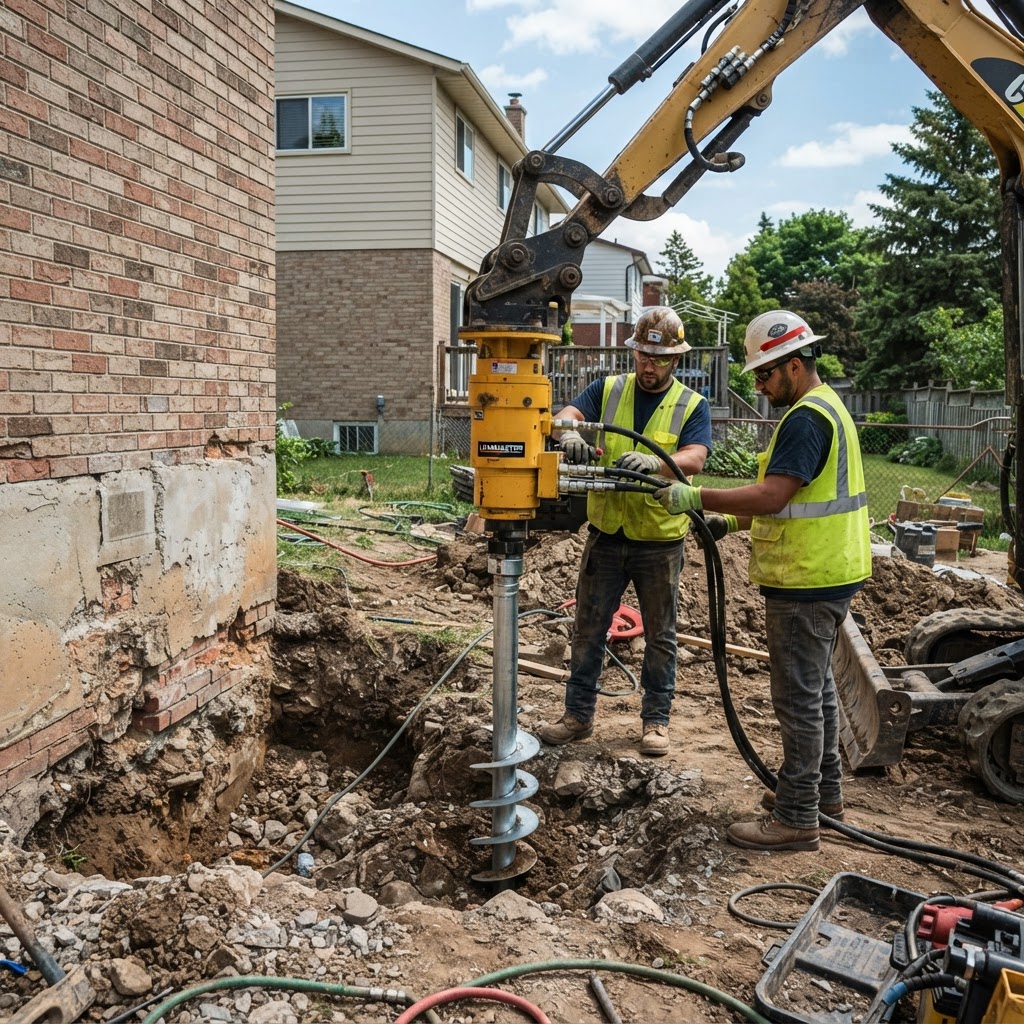
A helical pier stabilizes a foundation by transferring the structure's load from unstable near-surface soil down to competent bearing material. The pier is rotated into the ground, the helical plates engage the soil as they descend, and once the pier reaches the appropriate depth and capacity, a bracket connects it to the footing. The load then travels through the pier shaft rather than the compromised soil.
Steel Shaft
The central tubular shaft that forms the body of the pier and transfers load downward.
Helical Plates
Welded spiral plates that advance the pier into the ground through rotation, engaging soil as they descend.
Foundation Bracket
The steel bracket that connects the top of the pier to the existing footing, transferring the structure's load.
Load-Bearing Strata
The competent soil or bearing layer the pier reaches below unstable near-surface soils.
Step-by-step load transfer
- 1The steel shaft with helical plates is positioned at the footing.
- 2Hydraulic equipment rotates the pier into the ground.
- 3Helical plates engage soil layers as the pier descends.
- 4Installation torque is monitored to confirm bearing capacity.
- 5The pier reaches competent load-bearing strata.
- 6A bracket connects the pier to the existing footing.
- 7The structure's load transfers through the pier to the bearing layer.
Helical Piers vs Push Piers
Both helical and push piers transfer a foundation's load to competent bearing material, but they differ in how they are installed and the structures they suit. Neither is universally better—the right choice depends on the building, the soil, and the site.
| Factor | Helical Piers | Push Piers |
|---|---|---|
| Installation Method | Rotated into the ground (screw-like) | Hydraulically driven straight down |
| Dependence on Structure Weight | Independent of building weight | Uses building weight as reaction force |
| Typical Applications | Lighter structures, additions, porches | Heavier existing structures |
| Installation Monitoring | Torque-based capacity monitoring | Resistance-based capacity monitoring |
| Site Considerations | Rotational access, lighter equipment | Requires sufficient structure weight |
No universal winner. Helical piers excel where the structure is lighter or where rotational installation is practical; push piers excel where the building provides enough weight to drive the pier. The choice is made per property based on evaluation. Learn more about the alternative on our push pier installation page.
Helical Pier Installation Near Waldorf, MD
Helical pier installation follows a defined sequence, though exact processes vary by site, the number of piers, and access conditions. The workflow moves from exposing the footing to transferring the load and restoring the work area.
Foundation Access
Expose the footing at each planned pier location to allow bracket attachment.
Excavation at Support Points
Excavate only at pier locations rather than along the entire foundation, limiting site disruption.
Pier Positioning
Position the helical pier shaft and bracket at the footing for installation.
Rotational Installation
Hydraulic equipment rotates the pier into the ground through the helical plates.
Monitor Installation
Track installation torque to confirm the pier reaches competent bearing capacity.
Bracket Attachment
Secure the bracket to the footing, connecting pier and foundation.
Load Transfer & Stabilization
Transfer the structure's load through the pier to the bearing layer, arresting movement.
Backfill & Site Cleanup
Restore the excavated areas and leave the site in order.
Helical Pier FAQs for Waldorf Property Owners
Direct answers about what helical piers are, how deep they go, how they are installed, and when they are used instead of push piers for foundations in Waldorf and Southern Maryland.
Considering Helical Piers for Your Waldorf Property?
If your foundation is settling or a structure needs deeper support, helical piers may be one appropriate option—depending on the load, soil, and access at your property. Request an inspection or call to discuss whether helical pier installation fits your foundation condition with a contractor near Waldorf.
Waldorf Foundation Repair • Serving Waldorf, MD 20601 • Charles County • Southern Maryland