
Foundation Crack Repair in Waldorf, MD
Foundation cracks can develop for many reasons, and the appropriate repair depends on the crack's orientation, width, whether it is actively moving, moisture conditions, the foundation material, and the broader structural context. A horizontal crack, a stair-step crack, and a thin vertical hairline crack each tell a different story. Foundation crack repair in Waldorf begins with reading what the crack is communicating—then deciding whether sealing, reinforcement, stabilization, or a combination is the right response.
Types of Foundation Cracks Seen in Waldorf Homes
The direction and pattern of a foundation crack provide useful information about what may be happening behind it. Each pattern can be associated with different underlying conditions, though no crack can be fully diagnosed from appearance alone.
Vertical Cracks
Run up and down a poured concrete wall. Thin hairline vertical cracks often result from concrete shrinkage during curing, while wider or moving vertical cracks can warrant evaluation.
Horizontal Cracks
Run side to side, often mid-height on a basement wall. Horizontal cracking is frequently associated with lateral soil and hydrostatic pressure and can indicate wall bowing.
Stair-Step Cracks
Follow the mortar joints in block or brick masonry in a stepped pattern. These can be associated with differential settlement beneath the footing.
Diagonal Cracks
Run at an angle, often radiating from the corners of windows, doors, or other openings where the wall is weakened by the opening.
Hairline Cracks
Very narrow fractures, often under 1/16 inch. Many hairline cracks are cosmetic and stable, though monitoring helps confirm they are not widening.
Cracks Around Openings
Appear near windows, doors, and utility penetrations where the foundation wall has reduced continuity. These can reflect localized stress or movement.
Block Foundation Cracks
Cracking through concrete masonry unit (CMU) walls, commonly along mortar joints. Patterns and direction help indicate whether movement is involved.
Poured Concrete Wall Cracks
Cracks in solid poured walls, often vertical from shrinkage or horizontal from lateral pressure. The material behaves differently than block under stress.
Important: The direction of a crack is useful information, but it does not by itself determine the cause or severity. A horizontal crack may warrant evaluation sooner than a stable hairline crack, but width, movement, and surrounding symptoms all factor into whether repair is needed.
What Causes Foundation Cracks?
Foundation cracks develop when stress exceeds the material's tolerance. That stress can come from normal material behavior or from active structural movement. Distinguishing between the two is central to deciding whether a crack needs repair.
Shrinkage
As poured concrete cures and loses moisture, it shrinks slightly. This natural process commonly produces thin vertical hairline cracks, particularly in newer walls.
Settlement
When a footing loses support and settles, the wall above shifts, producing cracks—often stair-step in block or diagonal near openings.
Differential Movement
Uneven movement between sections of the foundation creates stress concentrations that crack walls along their weakest lines.
Hydrostatic Pressure
Saturated backfill pushing inward against a wall generates lateral force that commonly produces horizontal cracking.
Temperature & Moisture Change
Seasonal expansion and contraction cycles stress masonry and concrete, contributing to crack development over time.
Concrete Curing Stress
Rapid curing, inadequate curing conditions, or mix issues can increase shrinkage cracking during the wall's early life.
Masonry Movement
Block and brick walls crack along mortar joints when the masonry shifts, since joints are weaker than the units themselves.
Structural Stress
Loads exceeding the wall's design capacity—whether from soil pressure, loading changes, or support loss—produce cracking as a stress response.
Active movement versus a stable crack
A stable crack formed years ago during curing may need nothing more than monitoring or sealing. A crack that is widening, lengthening, or accompanied by wall displacement is a sign of active movement. Distinguishing between the two is essential, because sealing an active crack without addressing the movement typically results in a reopened repair. Monitoring crack width over time is one practical way to assess whether movement is ongoing.
How Foundation Cracks Are Repaired
Crack repair methods range from sealing and injection to full structural stabilization. The right approach depends on whether the crack is stable or active, whether water is entering, and whether the crack reflects underlying movement.
Crack Sealing & Injection
Epoxy or polyurethane injection fills cracks in poured concrete to restore continuity and stop water seepage. Best suited to stable cracks or moisture concerns.
Carbon Fiber Reinforcement
High-tensile straps bonded to the wall surface that resist further inward movement where cracking is tied to lateral wall pressure.
Structural Wall Reinforcement
Steel reinforcement or anchors that stabilize walls with more significant movement where carbon fiber alone is not appropriate.
Pier Stabilization & Underpinning
When cracking reflects footing settlement, piers or underpinning address the underlying support loss rather than the crack alone.
Masonry & Surface Repair
Mortar joint repair, patching, and surface restoration for block and masonry cracking where structural movement is not the primary concern.
Drainage & Moisture Management
Measures that reduce water pressure and moisture contributing to cracking, often paired with structural repair for a complete approach.
Sealing a crack may not address the underlying movement
Surface sealants and injection are effective when a crack is stable or when the goal is to stop water intrusion. However, if the crack is part of ongoing settlement or wall deflection, sealing alone will not stop the movement—and the repair is likely to reopen. In those cases, stabilization of the underlying cause should come first or alongside crack repair.
When Should a Foundation Crack Be Inspected?
Not every crack requires immediate evaluation, but certain combinations of symptoms make an inspection worthwhile. A single crack in isolation is less concerning than a crack accompanied by other signs of movement.
Monitoring a Crack
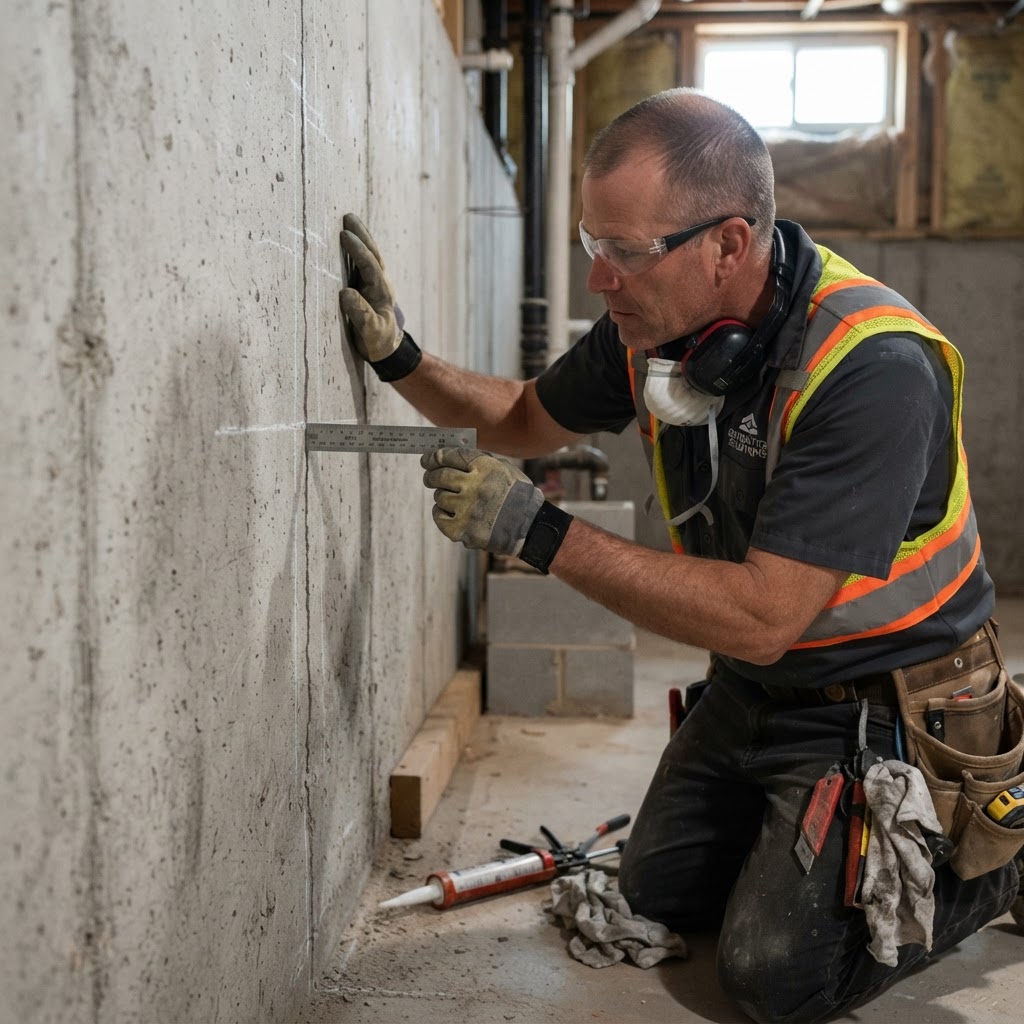
If you are unsure whether a crack is active, monitoring it over time provides useful information. Mark the ends of the crack with a small line and date, measure the width at a consistent point, and recheck after several weeks. If the mark extends or the width changes, the crack is likely active and warrants evaluation.
Related Foundation Services
Cracking often connects to broader foundation conditions. These related services may be relevant depending on what the evaluation finds:
Crawl space repair and commercial foundation services are also available as related options where the site conditions warrant them.
Detailed Guidance by Crack Type
Different crack patterns can mean different things. These supporting resources go deeper into specific crack types, what they can indicate, and how each is repaired.
Stair-Step Foundation Crack Repair
Stepped cracking in masonry and block walls, settlement relationships, and repair options.
Learn moreHorizontal Foundation Crack Repair
Lateral wall movement, bowing, and stabilization methods for horizontal cracks.
Learn moreVertical Foundation Crack Repair
Poured concrete cracking, shrinkage, water intrusion, and injection repair.
Learn moreFoundation Crack Injection & Sealing
Epoxy vs polyurethane injection, when sealing fits, and when it is not enough.
Learn moreFoundation Crack Repair FAQs for Waldorf Homeowners
Direct answers about vertical, horizontal, and stair-step cracks, injection, sealing, and when a crack warrants structural evaluation in Waldorf and Southern Maryland.
Have a Foundation Crack in Waldorf?
Whether you have spotted a horizontal crack, a stair-step pattern, a widening vertical crack, or water seeping through a basement wall, having the crack evaluated is the first step. Request an inspection or call to discuss what you are seeing with a foundation repair contractor.
Waldorf Foundation Repair • Serving Waldorf, MD 20601 • Charles County • Southern Maryland