Push Pier Installation in Waldorf, MD
Push piers are steel pier sections hydraulically advanced into supporting material using the weight of the existing structure as resistance during installation. Also called resistance piers, they are driven section by section straight down until they reach competent load-bearing material, then connected to the footing through a bracket that transfers the building's load off the compromised soil. Push pier installation in Waldorf is a common method for stabilizing heavier existing foundations that have settled, using the structure itself to install the support beneath it.
When Are Push Piers Used Near Waldorf?
Push piers are used when an existing foundation has settled and the structure provides enough weight to drive the pier sections to competent bearing material. Because they rely on the building's weight as reaction force, they are typically favored for heavier structures. Site conditions and structure configuration affect whether push piers are the right method for a given property.
Existing Foundation Settlement
Stabilizing footings on existing homes where settlement has caused downward movement and visible symptoms.
Heavier Structures
Supporting masonry and heavier buildings whose weight provides the reaction force needed to drive the piers.
Loss of Soil Support
Bypassing compromised near-surface soil to carry the structure's load to competent bearing material.
Foundation Stabilization
Arresting further downward movement by transferring load to a stable bearing layer.
Underpinning
Serving as a form of underpinning that extends foundation support deeper than the original footing.
Targeted Section Repair
Stabilizing one settled corner or wall rather than the entire foundation where movement is localized.
Method selection depends on the property. Push piers are not appropriate for every settling foundation. Lighter structures may not provide enough reaction weight, making helical piers a better fit. The choice depends on the building's weight, the soil, the access, and the repair objective— determined through evaluation.
How Push Piers Support a Settling Foundation
A push pier supports a settling foundation by extending the footing's load down to competent bearing material. After the footing is exposed and a bracket is fitted against it, steel pier sections are hydraulically driven into the ground. The building's own weight provides the reaction force that advances each section. Once the pier reaches firm bearing, the load transfers through the bracket and pier, stabilizing the footing at that location.
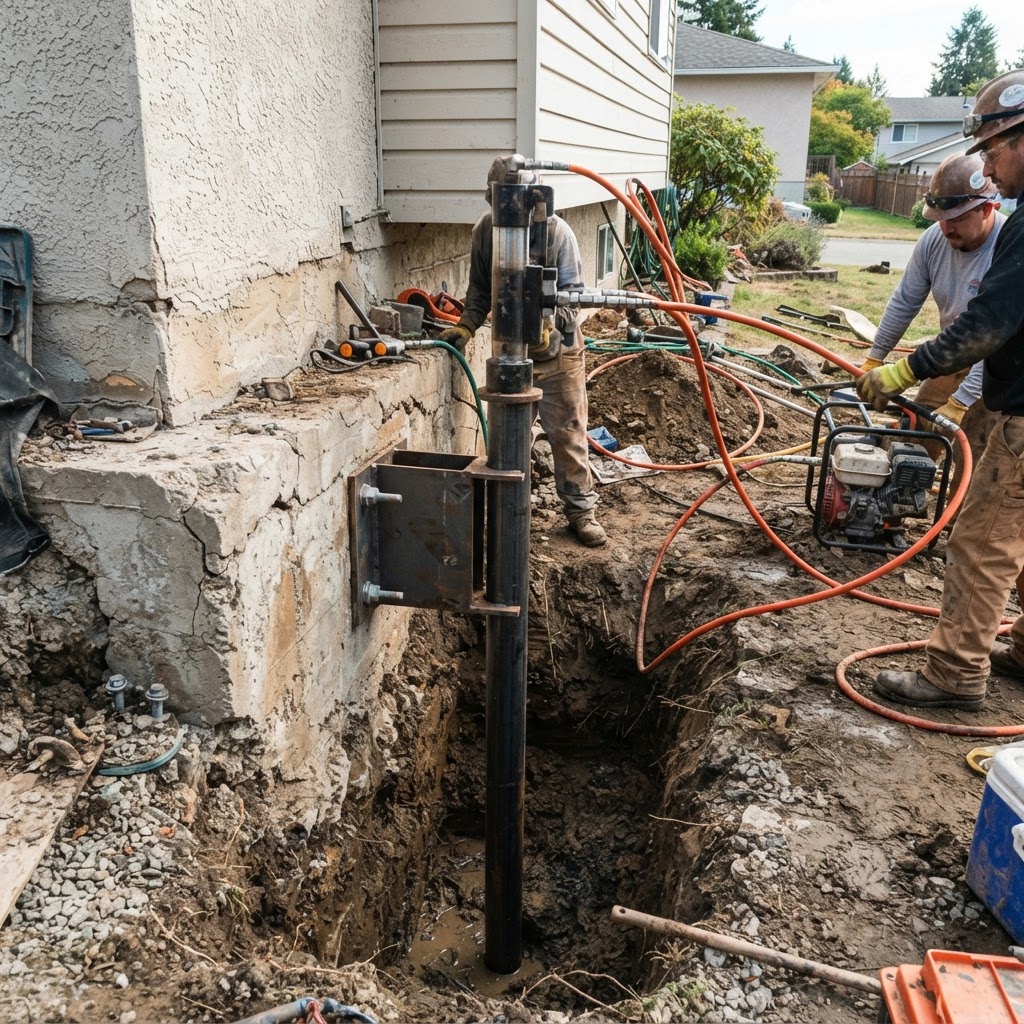
Excavation
Exposing the footing at each pier location to allow bracket installation.
Foundation Bracket
The steel bracket fitted against the footing that connects the pier to the foundation.
Steel Sections
Tubular steel pier sections driven one after another into the ground.
Hydraulic Advancement
Hydraulic force drives each section down using the building's weight as reaction resistance.
Step-by-step load transfer
- 1The footing is exposed at each pier location.
- 2A steel bracket is fitted against the footing.
- 3Hydraulic equipment drives the first steel section into the ground.
- 4Additional sections are added and driven one after another.
- 5The building's weight provides the reaction force for advancement.
- 6The pier reaches competent bearing material and resistance is confirmed.
- 7The structure's load transfers through the bracket and pier to the bearing layer.
- 8Stabilization is achieved at that footing location.
Push Piers vs Helical Piers for Foundation Repair
Push and helical piers both transfer a foundation's load to competent bearing material, but they differ in installation method and the structures they suit. Contractors evaluate several factors to choose between them—neither is universally better.
| Evaluation Factor | Push Piers | Helical Piers |
|---|---|---|
| Building Weight | Requires sufficient structure weight | Independent of building weight |
| Access | Hydraulic drive access at footing | Rotational drive access at footing |
| Foundation Construction | Heavier masonry and poured concrete | Lighter structures, additions, porches |
| Soil & Support Conditions | Driven to competent bearing by resistance | Rotated to competent bearing by torque |
| Repair Objective | Stabilization; controlled lifting where appropriate | Stabilization; controlled lifting where appropriate |
| Installation Conditions | Driven straight down, section by section | Rotated into ground like a screw |
Why contractors evaluate before choosing. The decision between push and helical piers comes down to the building's weight, the access, the foundation construction, the soil, and the repair objective. For lighter structures, see our helical pier installation page. The right method is selected per property, not assumed.
Push Pier Foundation Stabilization in Waldorf, MD
Push pier installation follows a defined sequence from exposing the footing to transferring the load. The exact scope varies by the number of pier locations and access conditions. Stabilization—arresting further movement—is the primary objective; controlled lifting is a separate consideration, not a guaranteed outcome.
Expose the Footing
Excavate at each pier location to expose the foundation footing for bracket installation.
Fit the Bracket
Position and secure the steel bracket against the footing.
Drive Steel Sections
Hydraulically advance pier sections into the ground using the building's weight as reaction.
Confirm Bearing
Continue driving until the pier reaches competent bearing material and resistance is confirmed.
Transfer Load
Engage the bracket to transfer the footing's load through the pier to the bearing layer.
Stabilization
Downward movement at that location is arrested as the load rests on competent material.
Controlled Lifting
Where appropriate and the structure tolerates it, apply controlled lifting toward original elevation.
Restore the Site
Backfill excavated areas and leave the work site in order.
Stabilization is different from guaranteed lifting
Push piers reliably stabilize a settling foundation by transferring load to competent bearing material. Controlled lifting back toward original elevation may be possible in appropriate conditions, but it is not guaranteed for every project. Whether lifting is realistic depends on the structure, the age of the movement, and the condition of the framing above. An evaluation sets realistic expectations for each property.
Push Pier FAQs for Waldorf Property Owners
Direct answers about what push piers are, how they stabilize a foundation, how deep they go, and how they differ from helical piers for homes in Waldorf and Southern Maryland.
Considering Push Piers for Your Waldorf Property?
If your heavier existing foundation is settling, push piers may be an appropriate stabilization method—depending on the building's weight, the soil, and the access at your property. Request an inspection or call to discuss whether push pier installation fits your foundation condition with a contractor near Waldorf.
Waldorf Foundation Repair • Serving Waldorf, MD 20601 • Charles County • Southern Maryland