Basement Wall Stabilization & Carbon Fiber Reinforcement in Waldorf, MD
Basement wall stabilization is the process of reinforcing a foundation wall that has cracked, bowed, or moved so that further inward deflection is arrested. Where the wall's condition is appropriate, carbon fiber reinforcement provides high tensile strength with a low profile that preserves interior space. But carbon fiber is one of several stabilization methods, and the right choice depends on the amount of deflection, the wall construction, and whether movement is ongoing. This page focuses on the reinforcement and stabilization methods used to hold a moving foundation wall in place—complementing the bowing basement wall repair page, which focuses on the problem itself.
Signs a Foundation Wall May Need Structural Reinforcement
Several signs can suggest that a foundation wall has moved enough to warrant reinforcement rather than cosmetic crack repair alone. These signs are indicators, not a diagnosis—the correct stabilization system depends on measuring the deflection and reviewing the wall's construction, not on a single visible symptom.
Horizontal Cracking
A horizontal crack across the wall, often near the midpoint, where lateral bending stress is greatest and the wall tends to bow inward.
Inward Wall Bowing
A visible inward curve or deflection, measurable with a straight edge, confirming the wall is no longer plumb.
Wall Deflection
A measurable inward offset of the wall from its original plumb position, often progressing slowly over time.
Recurring Wall Cracks
Cracks that return after cosmetic patching or sealing, indicating that movement is ongoing beneath the surface repair.
Stair-Step Masonry Cracks
Stepped cracks following mortar joints in block walls, which can accompany horizontal movement as the wall shifts.
Displacement
Block courses or wall sections pushed inward farther than adjacent areas, creating a visible step or offset in the wall.
Cracked Block Joints
Mortar joints opening or shearing as the wall moves, reducing the masonry's resistance to further deflection.
Movement Around Openings
Cracking near windows, doors, or other openings where the wall is weakened and stress concentrates during movement.
Visible symptoms do not determine the correct stabilization system by themselves. A horizontal crack and a quarter-inch of inward deflection may point to carbon fiber; the same crack with three inches of deflection and shear at the base may point to steel reinforcement or reconstruction. Measuring the wall's actual condition is what matches the method to the wall.
How Carbon Fiber Foundation Wall Reinforcement Works
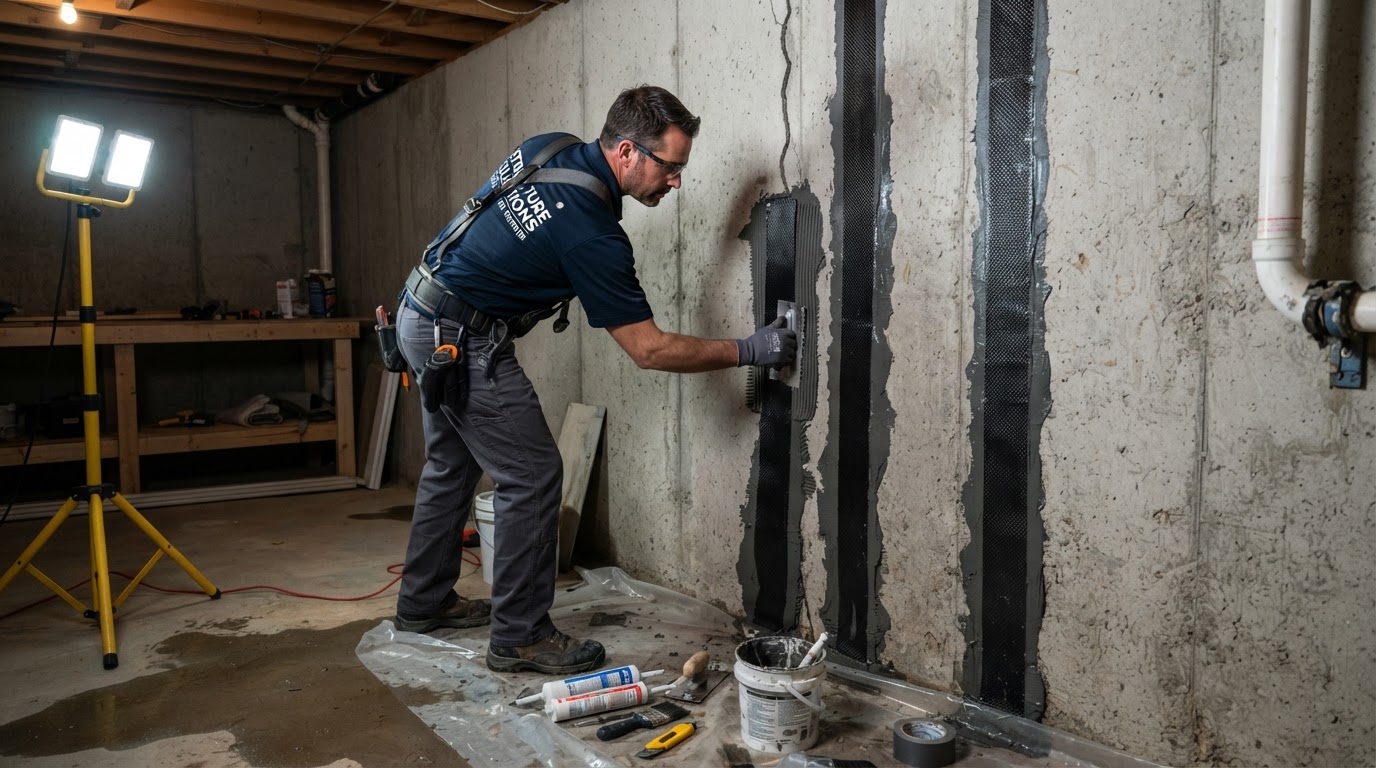
Carbon fiber reinforcement works by bonding a high-strength, high-tensile material directly to the interior surface of a foundation wall. Once bonded, the carbon fiber resists the tensile force that lateral soil pressure places on the wall as it tries to bow inward. Because the material is bonded across the area of movement, the resisting force is distributed along the wall rather than concentrated at one point.
The wall surface is prepared, the straps are saturated with structural epoxy and applied vertically from the floor to the top of the wall, and the epoxy cures to form a permanent bond. The result is a low-profile reinforcement that resists further inward movement while preserving usable interior space.
Carbon fiber provides tensile strength that resists the inward bending force on the wall.
Straps are bonded to the prepared interior wall surface with structural epoxy.
Force is distributed along the strap and across the wall area rather than at a point.
The thin straps preserve interior basement space and can often be concealed.
When carbon fiber may be considered
- Inward deflection is moderate and within the system's design range
- The wall has not severely sheared at the base or top course
- The wall surface is sound enough to bond with the epoxy
- Preserving interior space is a priority
When other methods may be necessary
Carbon fiber does not straighten a wall that has already bowed, and it is not suitable for every level of movement. Walls with significant deflection, shear displacement, or active structural failure may require steel reinforcement, wall anchors, or localized reconstruction instead. Carbon fiber is one tool among several—not a universal solution for every moving wall.
Foundation Wall Stabilization Options Near Waldorf
Beyond carbon fiber, several methods can stabilize a moving foundation wall. The right choice depends on the amount of deflection, the wall construction, and whether movement is active. No system is universally best—each suits a different range of wall conditions.
Carbon Fiber Reinforcement
High-tensile carbon fiber straps bonded to the interior wall surface with structural epoxy. Low-profile, minimal interior space loss, and appropriate for moderate inward deflection without severe shear.
Steel Bracing
Heavy-gauge steel I-beam or channel columns installed against the interior wall to resist greater inward deflection where carbon fiber is not suitable.
Wall Anchors
Where applicable, anchor systems that tie the wall back into stable soil outside, countering inward pressure by anchoring the wall against lateral load.
Masonry Repair
Repair of cracked mortar joints and displaced block courses once the wall has been stabilized and further movement arrested.
Crack & Drainage Repair
Crack sealing or injection alongside drainage improvements to reduce the hydrostatic pressure contributing to wall movement.
Structural Reconstruction
In conditions where reinforcement cannot arrest the movement, localized reconstruction of the affected wall section may be warranted.
Comparing Wall Stabilization Methods
A general comparison—actual selection depends on measured deflection and site evaluation.
| Repair Method | General Purpose | Typical Considerations |
|---|---|---|
| Carbon Fiber | Resist moderate inward deflection | Low profile; best without severe shear |
| Steel Bracing | Resist greater inward deflection | Occupies more interior space; for larger movement |
| Wall Anchors | Tie wall back into stable soil | Where applicable; requires exterior access |
| Masonry Repair | Restore cracked mortar joints | Performed after stabilization |
| Drainage Repair | Reduce hydrostatic pressure | Supporting measure; not a substitute for reinforcement |
| Reconstruction | Replace severely damaged section | Reserved for conditions reinforcement cannot arrest |
How Basement Wall Stabilization Works
The stabilization process moves from understanding the wall's actual condition to installing the appropriate reinforcement. While the specific steps vary with the method and the wall, the sequence is consistent: evaluate, measure, select, prepare, install, and review.
Inspect Cracking & Movement
Review the crack pattern, measure inward deflection, and confirm whether movement is active.
Evaluate Wall Construction
Determine whether the wall is poured concrete or block, its height, and its condition.
Review Wall Deflection
Measure how far the wall has moved to determine which stabilization methods remain viable.
Identify Moisture & Drainage
Assess hydrostatic pressure and drainage conditions contributing to the inward force.
Select Stabilization Method
Match the reinforcement—carbon fiber, steel, anchors, or another option—to the wall's condition.
Prepare the Wall
Clean and prepare the interior surface so the reinforcement bonds or mounts correctly.
Install Reinforcement
Apply the selected stabilization system using structural materials and proper technique.
Review Repaired Area
Confirm the installation and discuss drainage or maintenance considerations.
Basement Wall Stabilization FAQs
Direct answers about carbon fiber reinforcement, steel bracing, wall anchors, and how the right stabilization method is matched to a moving foundation wall in Waldorf and Southern Maryland.
Concerned About Foundation Wall Movement?
If you have noticed a horizontal crack, an inward curve, recurring cracks, or displaced block courses in a foundation wall, having the wall measured and evaluated is the first step toward understanding the movement. Request an inspection or call to discuss which stabilization method may be appropriate for your Waldorf property.
Waldorf Foundation Repair • Serving Waldorf, MD 20601 • Charles County • Southern Maryland