Bowing Basement Wall Repair in Waldorf, MD
A bowing basement wall is a foundation wall that has deflected inward toward the interior under lateral pressure from the soil and water outside it. As the soil expands, saturates, or shifts, it pushes against the wall, and the wall—limited in its resistance to lateral bending—bows inward, often developing a horizontal crack near its midpoint. Bowing basement wall repair in Waldorf focuses on arresting that inward movement with reinforcement or stabilization matched to the amount of deflection, the wall construction, and whether movement is ongoing.
Signs a Basement Wall May Be Moving
Wall movement produces recognizable patterns. A horizontal crack, especially one accompanied by inward deflection, is the signature sign of lateral pressure on a basement wall. Recognizing these signs supports earlier evaluation—without using a single symptom to declare the wall failed.
Horizontal Cracking
A horizontal crack running across the wall, often near the midpoint, where lateral pressure is greatest and the wall bends inward.
Inward Bowing
A visible inward curve or deflection of the wall, measurable as the wall pushes toward the basement interior at its center.
Wall Leaning
The wall tilting inward at the top or bottom, indicating that the wall has rotated or shifted under sustained lateral load.
Displaced Block Courses
In concrete block walls, individual courses of block pushing inward farther than those above or below, creating a visible step in the wall.
Cracks Near Corners
Cracking where the moving wall meets a perpendicular wall or corner, as the inward deflection stresses the joint between them.
Stair-Step Cracking
Stepped cracks that can accompany horizontal cracking as the wall shifts and the masonry adjusts to the movement.
Water Seepage
Water entering through the cracks that movement has created, since the cracked wall no longer resists moisture the same way.
Visible Wall Deflection
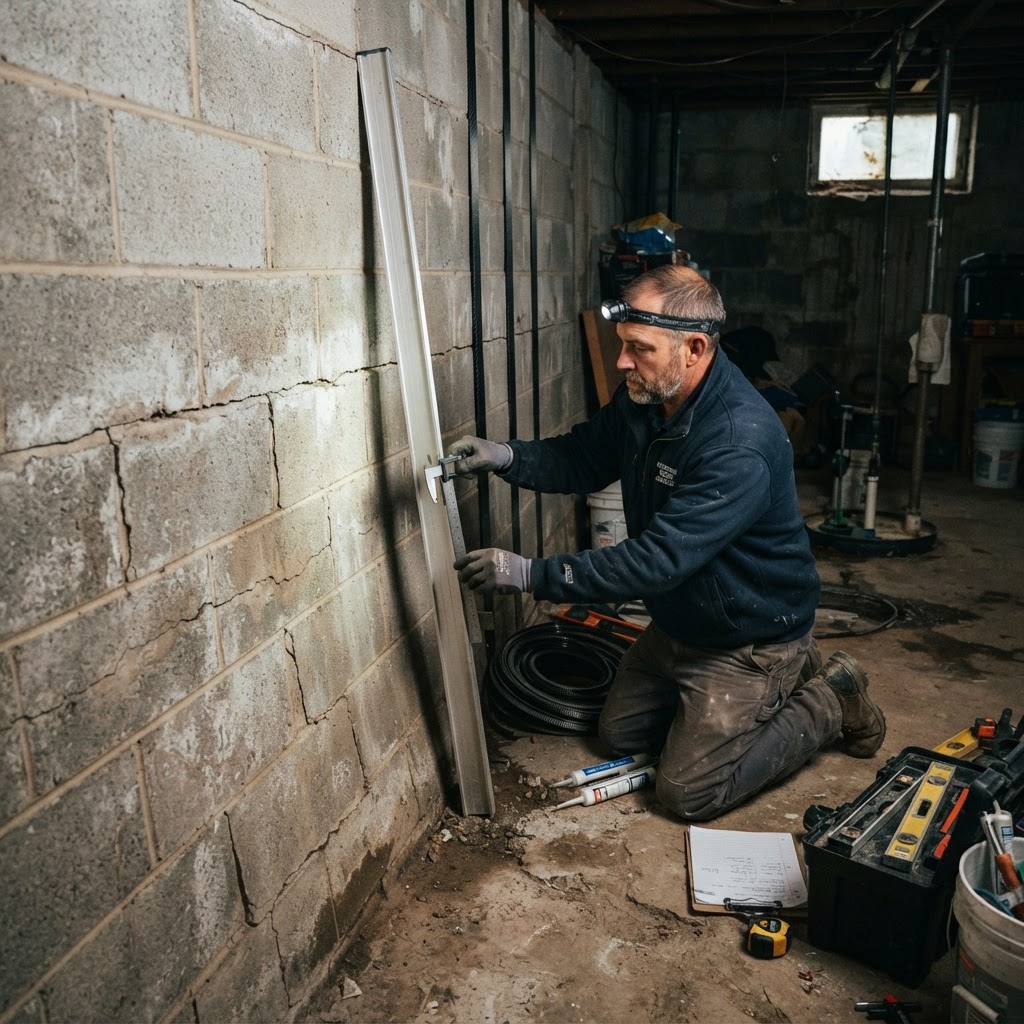
A measurable inward offset—often assessed with a straight edge or string line—confirming the wall is no longer plumb.
Why horizontal cracking warrants evaluation
A horizontal crack often indicates that lateral pressure has exceeded the wall's resistance to inward bending. While a horizontal crack does not by itself mean the wall is about to fail, it is the type of cracking most commonly associated with ongoing wall movement—and the type most worth evaluating sooner rather than later. This is not a cause for alarm, but a reason to have the wall measured and assessed.
What Causes a Foundation Wall to Bow?
Basement walls bow when the lateral force pushing inward from the surrounding soil exceeds the wall's ability to resist that force. Several conditions can contribute to that pressure; no single cause applies to every wall, and the contributing conditions at a given property require evaluation rather than assumption.
Lateral Soil Pressure
The soil surrounding the basement wall exerts constant inward force, which increases as the soil becomes saturated, expands, or is loaded from above.
Hydrostatic Pressure
Water trapped in the backfill against the wall adds the weight of standing water to the soil pressure, sharply increasing inward force during wet periods.
Drainage Conditions
Poor surface drainage, clogged perimeter drains, or downspouts discharging near the wall concentrate water against the foundation and raise hydrostatic pressure.
Soil Expansion & Contraction
Moisture-sensitive soils expand when wet and shrink when dry, cycling the wall under repeated lateral load and contributing to cumulative deflection.
Structural Loading
Loads from above—or changes in loading such as additions or framing changes—can alter how the wall carries force and contribute to movement.
Weakening Masonry
Deteriorating mortar joints or block over time reduce the wall's resistance to lateral pressure, allowing deflection to progress.
Long-Term Movement
Sustained pressure over years can cause gradual, cumulative bowing that becomes visible only after the wall has deflected enough to produce cracking.
Basement Wall Stabilization Options Near Waldorf
Several methods can stabilize a bowing wall. The right choice depends on the amount of inward deflection, the wall construction, whether movement is active, and the site conditions. Not every method suits every wall.
Carbon Fiber Reinforcement
High-tensile carbon fiber straps bonded to the interior wall surface with structural epoxy, resisting further inward movement with minimal loss of interior space. Appropriate for moderate deflection without severe shear.
Steel Reinforcement
Heavy-gauge steel I-beam or channel columns installed against the interior wall, providing structural resistance for walls with greater deflection or where carbon fiber is not suitable.
Wall Anchors
Where applicable, anchor systems that tie the wall back into stable soil outside, countering inward pressure by anchoring the wall against lateral load.
Structural Bracing
Additional bracing tailored to the wall's construction and the amount of movement, selected when reinforcement alone is not sufficient.
Masonry Repair
Repair of cracked mortar joints and displaced block courses once the wall has been stabilized and further movement arrested.
Drainage Improvements
Measures to reduce the hydrostatic pressure contributing to movement—often a supporting part of the plan, though not a substitute for structural stabilization.
Carbon fiber has appropriate and inappropriate applications
Carbon fiber reinforcement is an excellent option for walls with moderate inward deflection and no severe shear at the base or top course. It is not a universal solution. Walls with significant bowing, shear displacement, or active structural failure may require steel reinforcement or anchors instead. Carbon fiber does not repair every bowing wall—matching the method to the wall's actual condition is the purpose of the evaluation.
Evaluating Bowing Basement Walls in Waldorf
Evaluating a bowing wall is about more than noting that it has moved. The evaluation measures how far it has deflected, identifies the cause of the pressure, and determines which stabilization method fits the wall's actual condition. Early evaluation matters because the range of viable repair options can narrow as deflection increases.
Horizontal, stair-step, or corner cracking each indicate different aspects of the wall's movement.
Measured inward deflection helps determine which stabilization methods remain viable.
Poured concrete and concrete block behave differently under lateral pressure and suit different repairs.
The source and severity of water pressure contributing to the inward force.
How surface water and downspout discharge are managed around the foundation.
Wall height, openings, and how the wall ties into the overall foundation.
Whether prior repairs are holding or showing signs of continued movement.
Whether the wall is still moving or has stabilized at its current deflection.
Why Early Evaluation Matters
A wall caught early in its movement has a wider range of stabilization options, often including less invasive approaches like carbon fiber. As deflection increases, steel reinforcement or anchors may become necessary, and the complexity and cost of stabilization rise. Evaluating early does not mean rushing— it means understanding the wall's condition before the range of options narrows.
Related Foundation Services
Bowing walls often connect to cracking and broader foundation conditions:
Block and concrete foundation repair services are also available as related options where the site conditions warrant them.
Bowing Basement Wall FAQs for Waldorf Homeowners
Direct answers about horizontal cracks, carbon fiber reinforcement, hydrostatic pressure, and what a wall stabilization inspection involves for homes in Waldorf and Southern Maryland.
Is Your Basement Wall Bowing in Waldorf?
If you have spotted a horizontal crack, an inward curve, or displaced block courses in a basement wall, having the wall measured and evaluated is the first step toward understanding the movement. Request an inspection or call to discuss what you are seeing with a foundation repair contractor near Waldorf.
Waldorf Foundation Repair • Serving Waldorf, MD 20601 • Charles County • Southern Maryland