Commercial Foundation Repair in Waldorf, MD
Commercial foundation concerns can involve settlement, foundation cracking, uneven slab or floor conditions, wall movement, support deficiencies, and structural stabilization needs. Commercial and light-commercial buildings carry different structural loads than homes and often present different access and occupancy considerations. This page outlines how foundation problems are evaluated and stabilized for commercial properties in and around Waldorf, with an approach that accounts for building use, access, and the need to coordinate with other professionals when a project requires it.
Commercial Foundation Problems We Evaluate Near Waldorf
Commercial buildings can develop the same categories of foundation problems as homes—settlement, cracking, wall movement—but with different structural loads, larger footprints, and access considerations that affect how the problem shows up and how it is repaired.
Differential Settlement
Uneven settling between sections of the foundation that twists framing and stresses connections.
Foundation Cracks
Cracking in walls, slabs, or masonry that can reflect settlement, movement, or stress.
Wall Movement
Inward or outward deflection of foundation walls under lateral soil and hydrostatic pressure.
Uneven Floors
Slab or framed floors that slope or settle, affecting use of the space and equipment placement.
Localized Sinking
One wing, corner, or addition dropping while the rest of the structure remains stable.
Addition Separation
Separation between an addition and the main structure at the connection joint.
Masonry Cracking
Stair-step or diagonal cracking in exterior masonry that follows foundation movement.
Water Intrusion
Water entering through cracks or joints, sometimes tied to the same pressure driving movement.
Support Deficiencies
Inadequate or deteriorated support that allows movement under the building's loads.
Different loads and access considerations
Commercial buildings often carry heavier loads, span larger areas, and have different access constraints than homes—interior finishes, equipment, occupancy, and limited exterior access all shape how a foundation problem is evaluated and how a repair is sequenced. These factors influence which stabilization methods are practical for a given property.
Commercial Foundation Repair and Stabilization Options
The same stabilization technologies used for residential foundations apply to commercial properties, but selection depends on the building's loads, access, and foundation construction. No single system is suitable for every commercial structure.
Helical Piers
Steel shafts with helical plates rotated into competent bearing strata for settlement stabilization and addition support.
Push Piers
Hydraulically driven steel sections that use the building's weight to reach firm bearing material, suited to heavier structures.
Underpinning
Strengthening or extending foundation support to arrest settlement and restore load-bearing capacity.
Wall Stabilization
Carbon fiber, steel reinforcement, or anchors for foundation walls showing inward movement.
Crack & Concrete Repair
Crack injection, sealing, and masonry or concrete repair once movement has been addressed.
Localized Structural Support
Targeted support for a settled section, wing, or addition without requiring work across the entire foundation.
Not every system suits every commercial structure. A heavier building may be a candidate for push piers, while a lighter structure or an addition may suit helical piers. Limited access or an occupied interior may favor one method over another. The appropriate stabilization method is determined by evaluating the building's loads, foundation construction, and site conditions—not by applying a single default system.
Planning a Commercial Foundation Repair Project
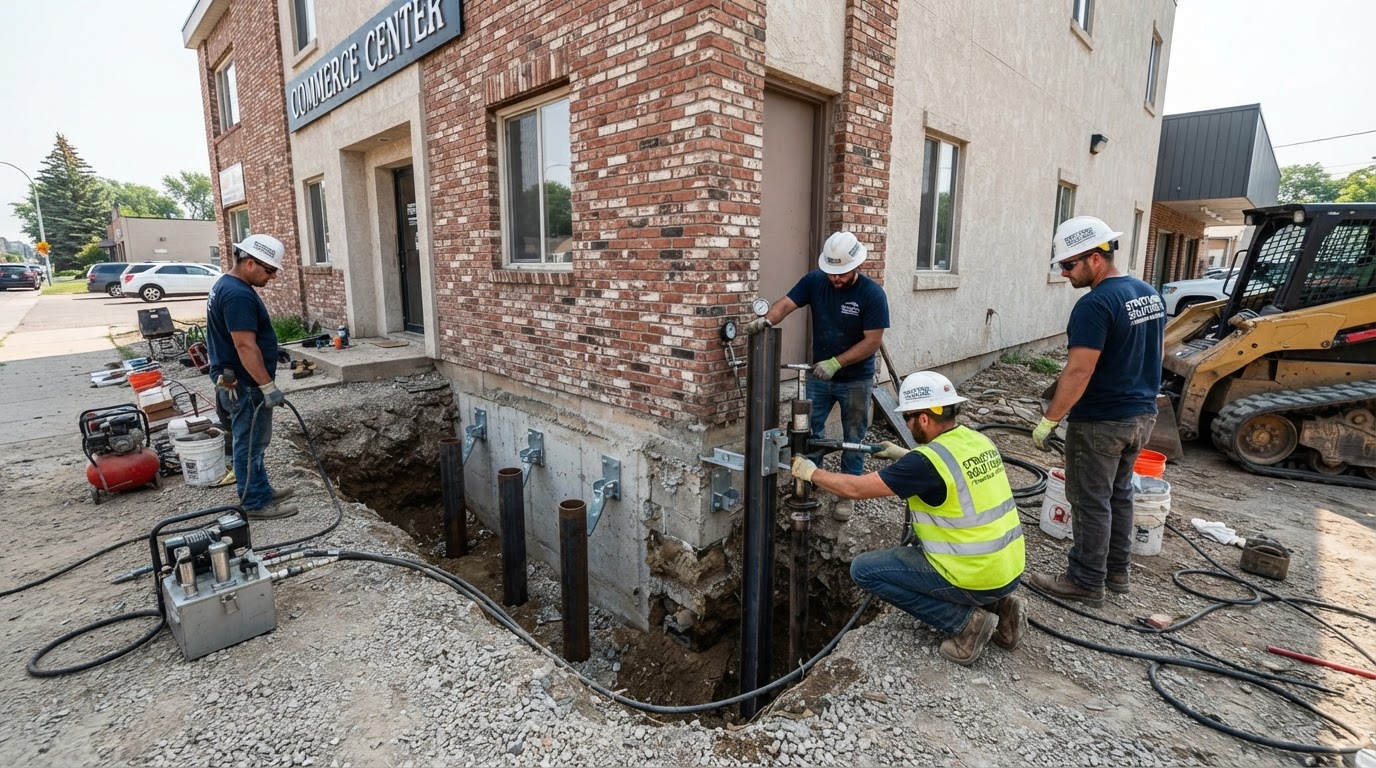
Planning a commercial repair involves more than selecting a stabilization method. Building use, occupancy, access, and coordination with other professionals all shape how the work is sequenced and performed. The planning process accounts for these factors so the repair fits the property and its operations.
Building Use
How the building is used shapes which areas can be accessed and how disruption is managed.
Access
Interior and exterior access constraints that affect where equipment and work can be positioned.
Occupancy
Whether the building remains occupied during repair, which influences sequencing and scheduling.
Equipment
The equipment required for the selected stabilization method and the space to operate it.
Foundation Type
The foundation construction—slab, wall, footing—that the stabilization must engage.
Structural Loads
The building's loads, which influence which pier or support systems are appropriate.
Affected Areas
The specific zones of the foundation that require stabilization versus those that are stable.
Repair Sequencing
The order of work across zones to manage load transfer and occupancy during the project.
Site Constraints
Property lines, adjacent structures, utilities, and other conditions that shape the approach.
Professional Coordination
Coordination with engineers or other professionals when a project requires their involvement.
Waldorf Foundation Repair is a foundation repair contractor, not a structural engineering firm. When a commercial project requires engineering design or stamped drawings, that work is coordinated with the appropriate licensed professionals. The role here is to evaluate foundation conditions, perform stabilization, and coordinate with other professionals as a project requires—not to replace engineering services that must be provided separately.
Commercial Foundation Repair in Waldorf, MD
The commercial repair process moves from discussing observed conditions to completing and reviewing the stabilization work, with coordination steps that reflect the building's use and occupancy.
Discuss Building Conditions
Review observed signs—cracking, sloping, movement, water—and the history of the changes.
Inspect Accessible Areas
Evaluate the accessible foundation areas, crack patterns, and signs of movement.
Identify Affected Zones
Determine which sections of the foundation require stabilization and which are stable.
Review Repair Objectives
Confirm the goals—stabilization, support restoration, or controlled leveling—and constraints.
Determine Methods
Select the appropriate stabilization methods based on loads, access, and foundation construction.
Coordinate Sequence
Plan the order of work across zones, accounting for occupancy and professional coordination.
Complete Repair
Perform the approved stabilization using professional equipment and structural materials.
Review Repaired Areas
Walk through the completed work and discuss maintenance considerations such as drainage.
Commercial Foundation Repair FAQs
Direct answers about commercial foundation settlement, pier systems, underpinning, and how a stabilization method is selected for commercial and light-commercial properties in Waldorf and Southern Maryland.
Commercial Foundation Concern Near Waldorf?
If your commercial or light-commercial building is showing settlement, cracking, wall movement, or uneven floors, an evaluation of the accessible foundation areas is the first step toward understanding the condition and the appropriate stabilization approach. Request an inspection or call to discuss the building and what you are observing.
Waldorf Foundation Repair • Serving Waldorf, MD 20601 • Charles County • Southern Maryland